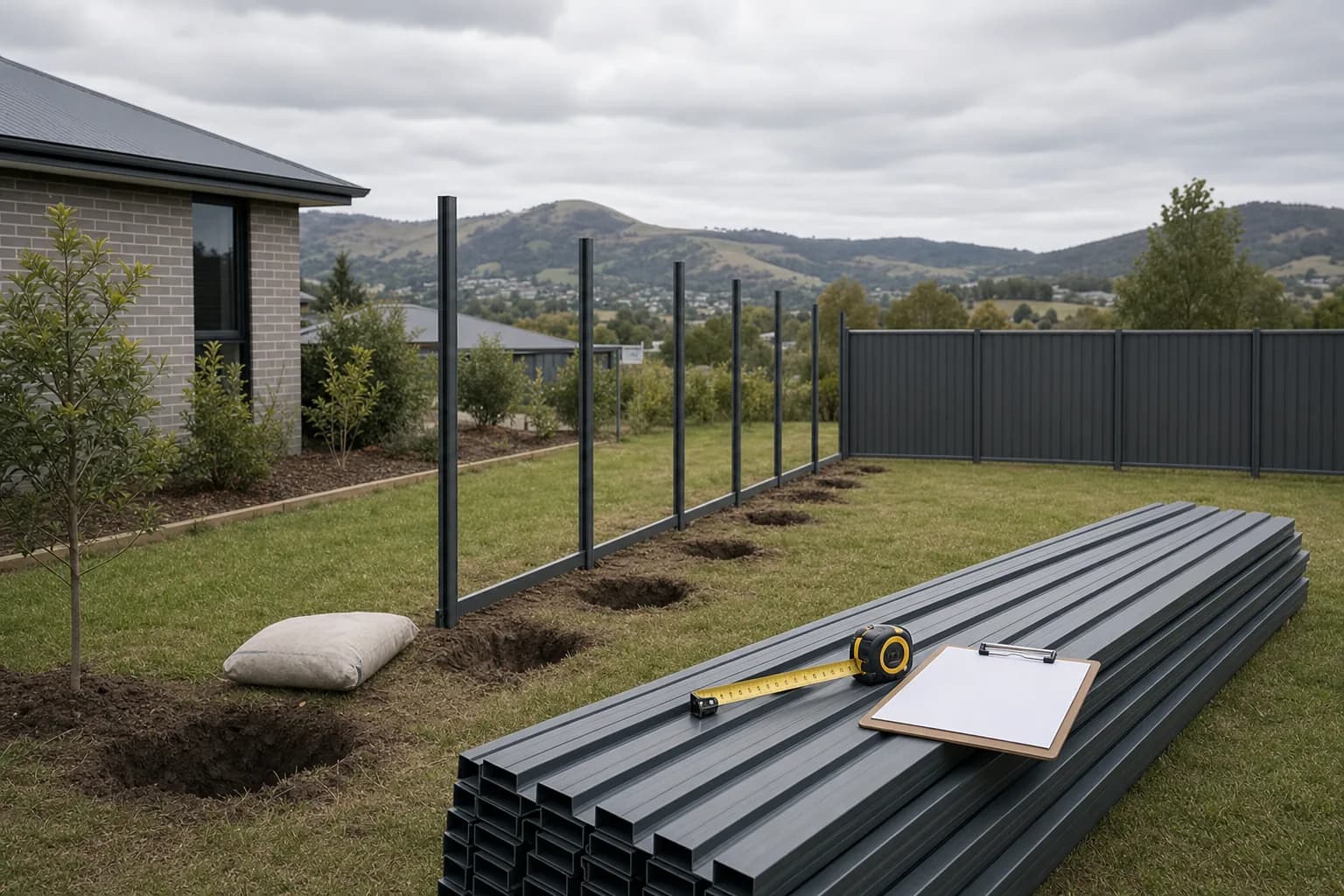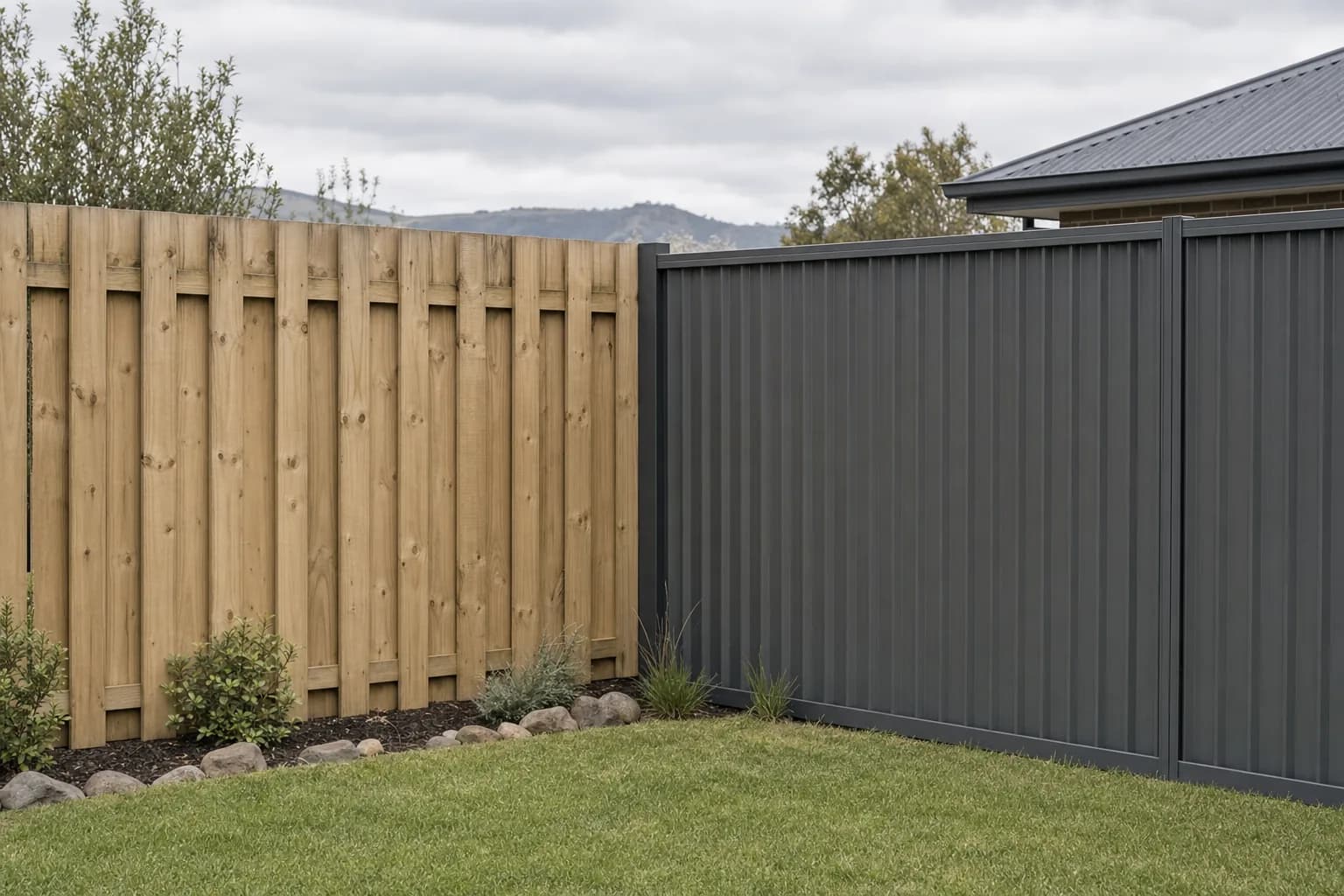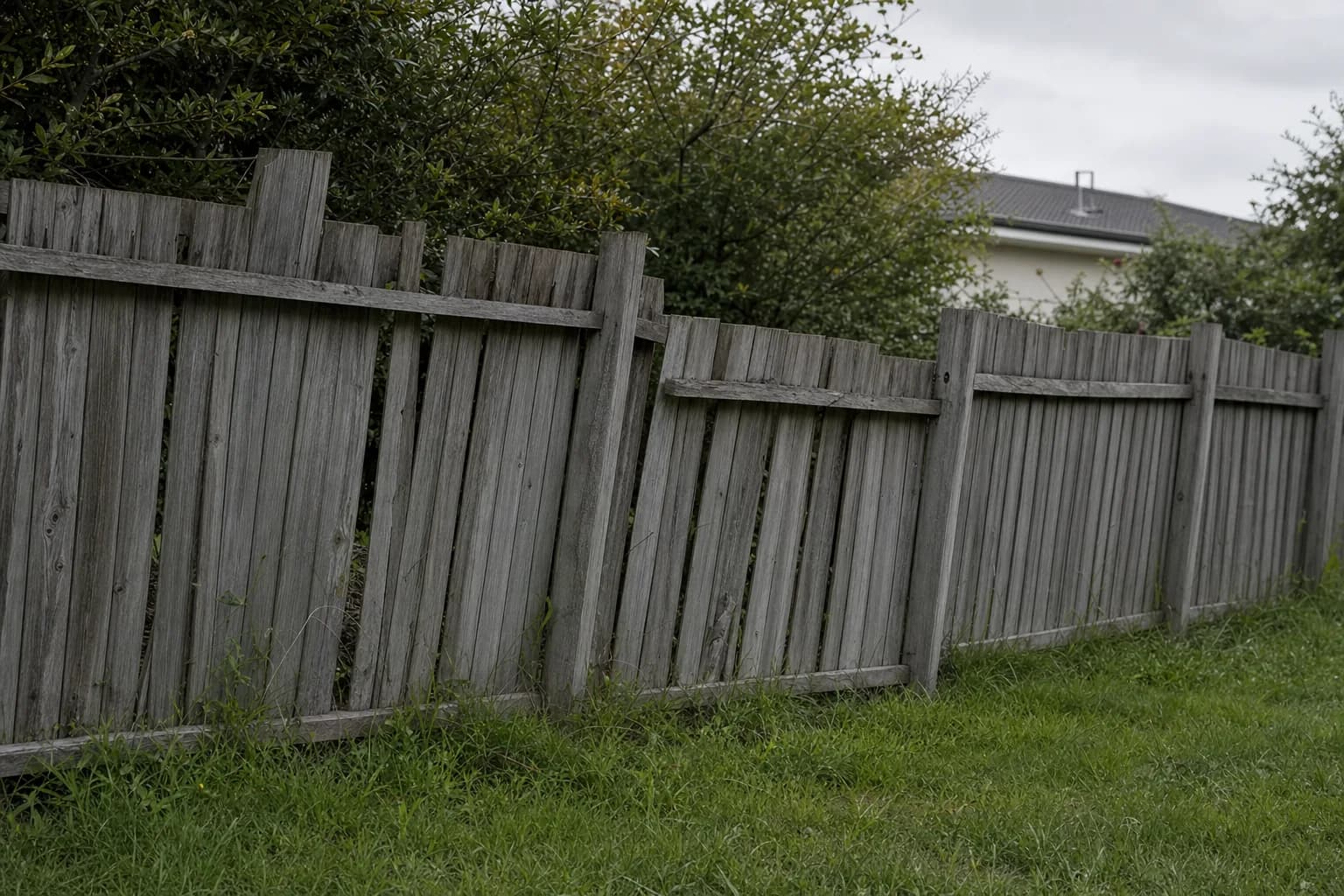
The first surprise in a Launceston fencing quote is often not the number. It is the sentence about stepping the fence down the block, because it means the fence will not look like the one you pictured.
Launceston is built across hills, so a level boundary is the exception. Once the ground falls away a fence has two honest ways to deal with it, and they look completely different.
Level Ground Is the Exception Here
Riverside blocks fall away toward the river. Norwood went in as terraced subdivision, so its boundaries often change level partway along. Even flatter suburbs have some fall from street to back fence.
A fence panel is a rectangle, whether that is a Colorbond sheet or a run of timber rails. Ground that falls away is not. Something has to give.
So the fence either steps down in separate level panels, with a visible drop between them. Or it rakes, meaning the rails run parallel to the ground while the palings stay vertical.
Fall Along the Run, and Cross-Fall Across It
Boundaries rarely fall in one direction only. A back fence can drop along its length and also tilt across it, so your ground sits higher than the ground next door.
That cross-fall decides how the bottom of the fence meets the dirt on each side. A run that looks tight from your lawn can show daylight from the neighbour's, so we walk both sides before setting a line.
Stepping: Level Panels With Visible Drops
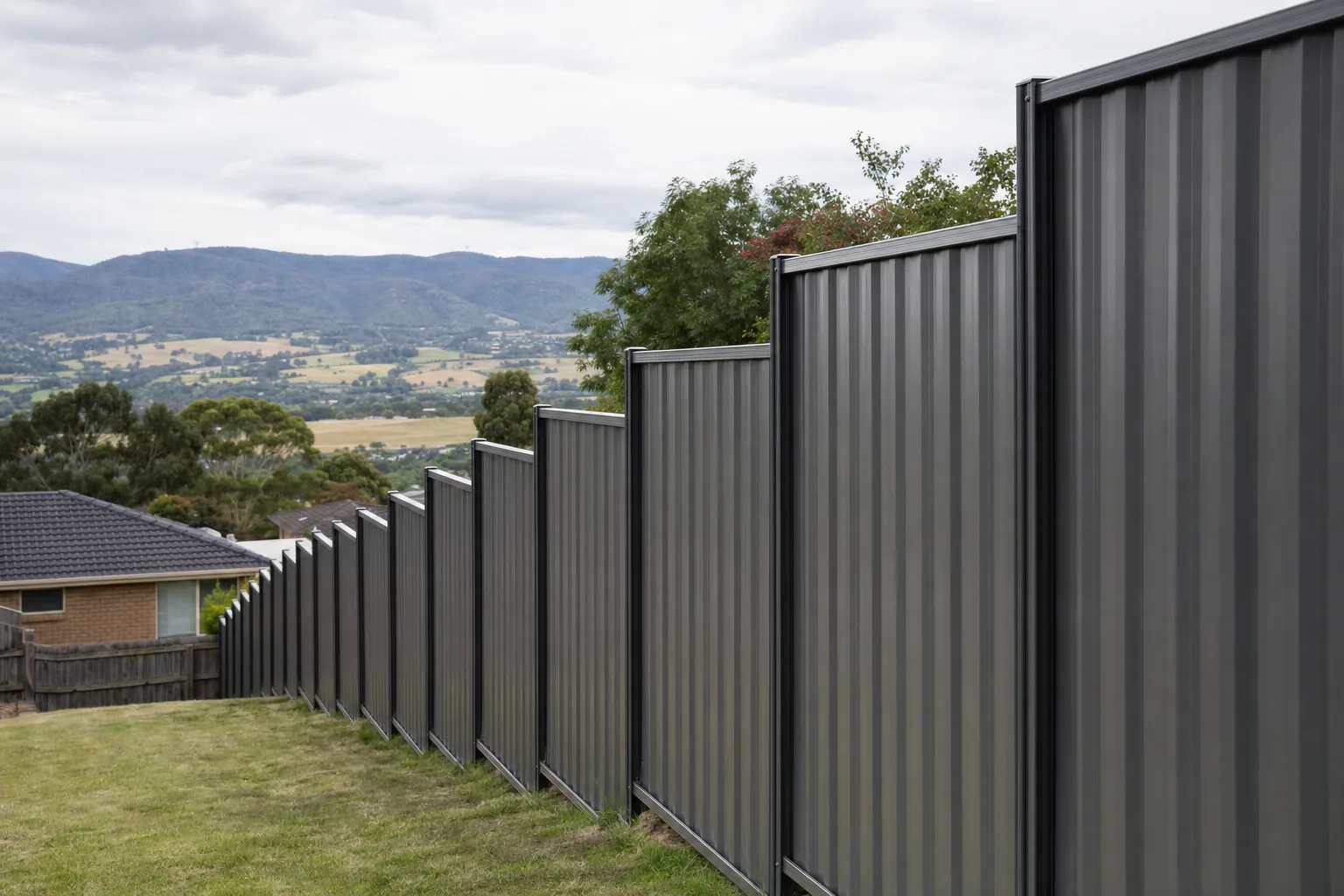
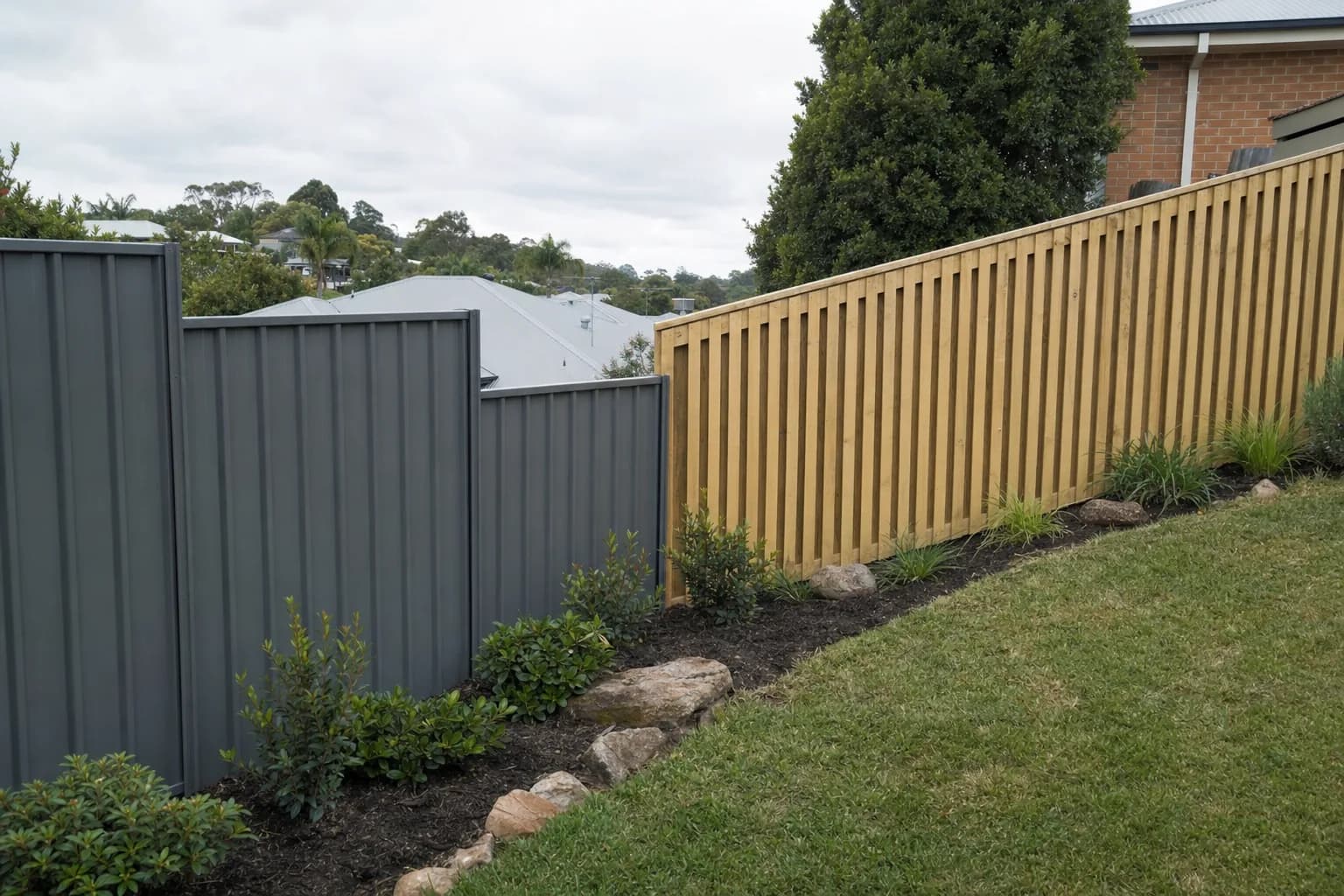
A stepped fence is a series of level panels. Where the ground drops, the next panel starts lower, so the top of the fence descends as a staircase rather than a smooth line.
It reads as deliberate, because every panel is level and the sheets, rails and capping sit true. Steel wants this treatment. A Colorbond sheet is a fixed rectangle captured in a rail top and bottom, so it cannot follow a grade without being cut on an angle.
Stepping is the default on a terraced block
Where a boundary changes level partway along, like the terraced blocks through Norwood, a single straight run either floats off the ground or buries itself. Stepped panels follow each terrace instead.
Raking: The Rails Follow the Ground
A raked fence runs parallel to the ground. The rails tilt with the slope, the posts stay plumb, and the palings or pickets hang vertically off the raked rails.
The win is no gap underneath. On a steady, even grade a raked run looks like it grew out of the block, and the eye reads one line instead of a staircase. Timber rakes more happily than steel, because rails cut to any angle and every paling is fixed individually.
Where Raking Stops Working
Raking needs the fall to be reasonably even. If the ground rolls or changes grade partway along, a raked run follows every wobble and the top of the fence starts to look like it is sagging.
It is less forgiving out the front. On a short picket frontage stepping usually looks more deliberate, because the eye has the house and the footpath to compare against.
The Gap Under a Stepped Fence
This is what people notice afterwards. Every panel on a stepped fence is level but the ground under it is not, so each panel meets the dirt at one end and lifts away at the other.
That leaves a wedge shaped gap along the bottom of each step. It is not a mistake and it is not poor workmanship. It is the arithmetic of standing a level panel on sloping ground.
Whether it matters is down to you. A dog that digs, a toddler, or a yard where you wanted no line of sight will find those gaps in the first week.
- Fit a plinth, a board or strip under the panel that closes the wedge
- Reshape the ground under a step so it sits closer to level, where drainage still allows it
- Rake the fence instead, and accept a top line that follows the ground
- Step it and accept the gaps, which plenty of people do once they have seen them
- Mix the two: step the steep section and rake the gentle one
Ask to see where the steps land
Ask us to walk the line at the measure and show where each step falls and how big a gap it leaves. Decide on a plinth before the job is priced, not after the panels are up.
Slope Changes the Quantities, Not the Rate
There is no slope surcharge, and if you see one on a quote, ask what it is for. A stepped fence simply uses more posts and more panels over the same distance than a flat run of the same length.
Every change of level needs a post at the step, so spacing is driven by where the ground drops rather than an even rhythm. Panels are cut to suit each step, and the set out takes longer.
Read the fall in the quantities
On a sloping job, compare the post and panel counts between quotes rather than hunting for a slope line. That is where the fall is priced, and it is why an on-site measure matters here.
When the Fence Sits on Top of a Retaining Wall
A lot of Launceston boundaries are not a fence on dirt. They are a fence on top of a retaining wall, which is how a sloping block was turned into a flat, useable yard.
The thing to understand is height. From your garden it looks like an ordinary boundary fence, but the neighbour on the low side sees the wall and the fence stacked together, and that total is what counts.
So we measure from the low side. A picket or slat fence on top of one of the Norwood walls ends up a good deal taller from the footpath than it looks from your lawn.
Where we stop on retaining walls
We will build a fence on top of a wall, and we will say plainly if the wall is not up to it. We do not engineer, repair or certify retaining walls. That is another trade, and it happens first.
Height above a wall is worth a council check for your address. We build to the standards, we are not the regulator, and we do not give legal advice.
Gates on a Slope Are Their Own Problem
A gate has to swing, and the ground it swings over is not level. A gate that clears at the hinge can foul the ground halfway through its arc, because the leaf sweeps across the fall while the hinge stays put.
That is easy to design around once it is known. Hanging the gate to open downhill works, and so does a sliding gate on a level track. The mistake is finding out after the gate is hung.
Step It If, Rake It If
Here is the recommendation rather than a shrug. Find the line below that sounds like your boundary, and if two of them do, get both priced at the same measure.
- Step it if the fence is Colorbond or any panel system, because the sheets sit level
- Step it if the boundary changes level partway along, like a terraced Norwood block
- Step it if the fall is steep, uneven, or rolls through the run
- Step it if the fence sits on a retaining wall, which is already a set of levels
- Rake it if the fall is steady and even, and the fence is timber paling or picket
- Rake it if a gap under the fence is unacceptable and you do not want a plinth
- Rake it if you want the boundary to read as one line rather than a staircase
What to Ask For at the Quote
You do not need to have decided before we arrive. You do need it decided out loud, standing in front of the boundary.
- Whether the run is stepped, raked, or a mix of both, stated on the quote
- Where the steps land, walked with a string line so you can see it
- Whether a plinth or infill is included, priced as its own line
- The post and panel count, so you can see how the fall is being paid for
- The height measured from the low side wherever there is a wall or heavy cross-fall
- How each gate will clear the ground through its full swing
Sloping sites, retaining walls and tight access are normal work for us across Launceston. What makes them go wrong is nobody talking about the fall before the posts go in.
Want a real number for your block?
We walk the boundary, measure it properly, and send an itemised quote in writing within 48 hours.