
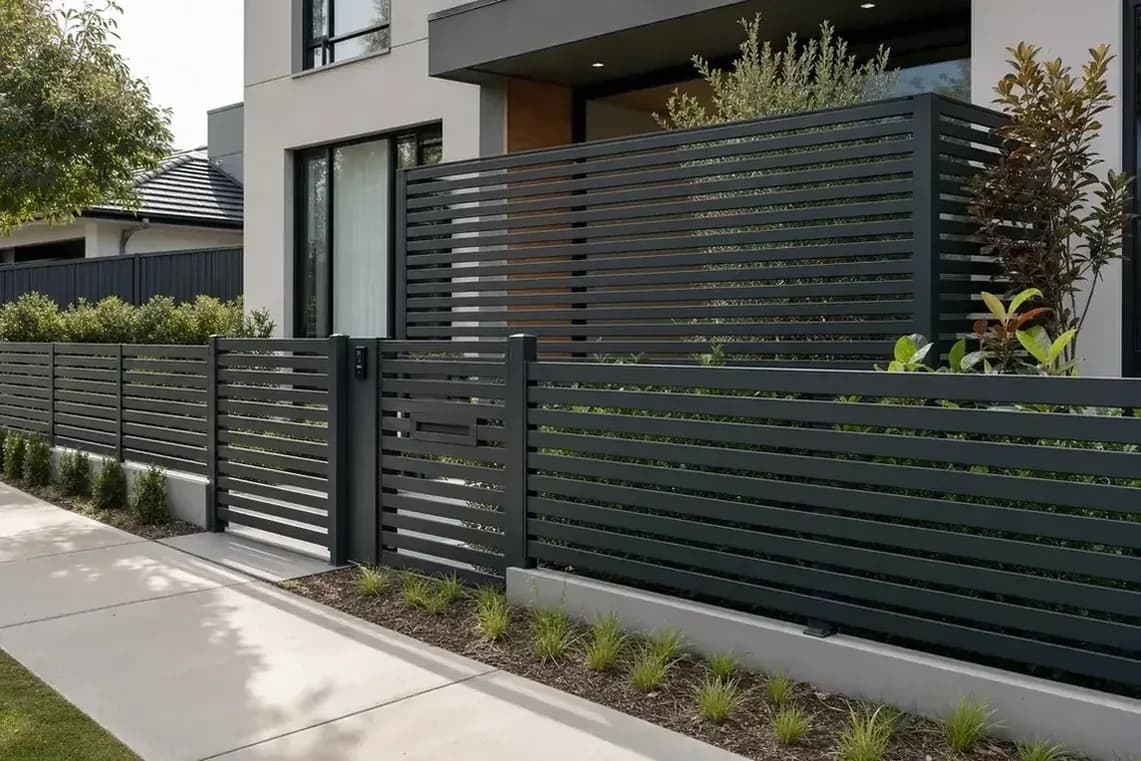
Aluminium & Slat Fencing
Aluminium Slat Fencing in Launceston
Aluminium slat fencing is a framed run of powder-coated blades fixed to aluminium posts, set with a deliberate gap between each one. It is the fence people choose when the look of the boundary matters as much as the job it does.
2
Slat orientations
100%
Powder-coated aluminium
48hr
Written quote
Zero
Subbies on your job
Why Slat
A Modern Boundary That Still Lets the Block Breathe
Horizontal slats give a Launceston frontage a sharp, contemporary line that a solid panel never will. They also let light and air through, so the yard behind them still feels open.
An aluminium slat fence is built from extruded aluminium blades fixed into a frame, with the gap between blades set to whatever you want. The posts, rails and slats are all aluminium, powder-coated in the factory before they reach your block. Nothing about it needs painting, oiling or sealing once it is standing.
Most people come to us for it because of the front boundary. A run of horizontal slats reads as one clean architectural line, and it lifts a plain frontage far more than a solid panel does. The gaps do real work too, letting light into a narrow front yard and letting a breeze through.
It also handles the Tamar Valley well. Aluminium does not rust the way raw steel does, and it does not swell, cup or rot the way timber does through a wet Launceston winter. The powder-coat is baked on, so the colour holds without an annual repaint.
It suits front fences, driveway returns, screening around a pool pump or bins, and any spot where you want a boundary that looks designed rather than default. It is not the cheapest fence per metre and it does not give you full privacy. If those are your priorities, a solid panel run is the better call.
What a Slat Fence Actually Does
Three things set a slat run apart from the solid panel fence it usually sits next to.
Powder-Coated Aluminium
Built to Sit Outside and Stay Sharp
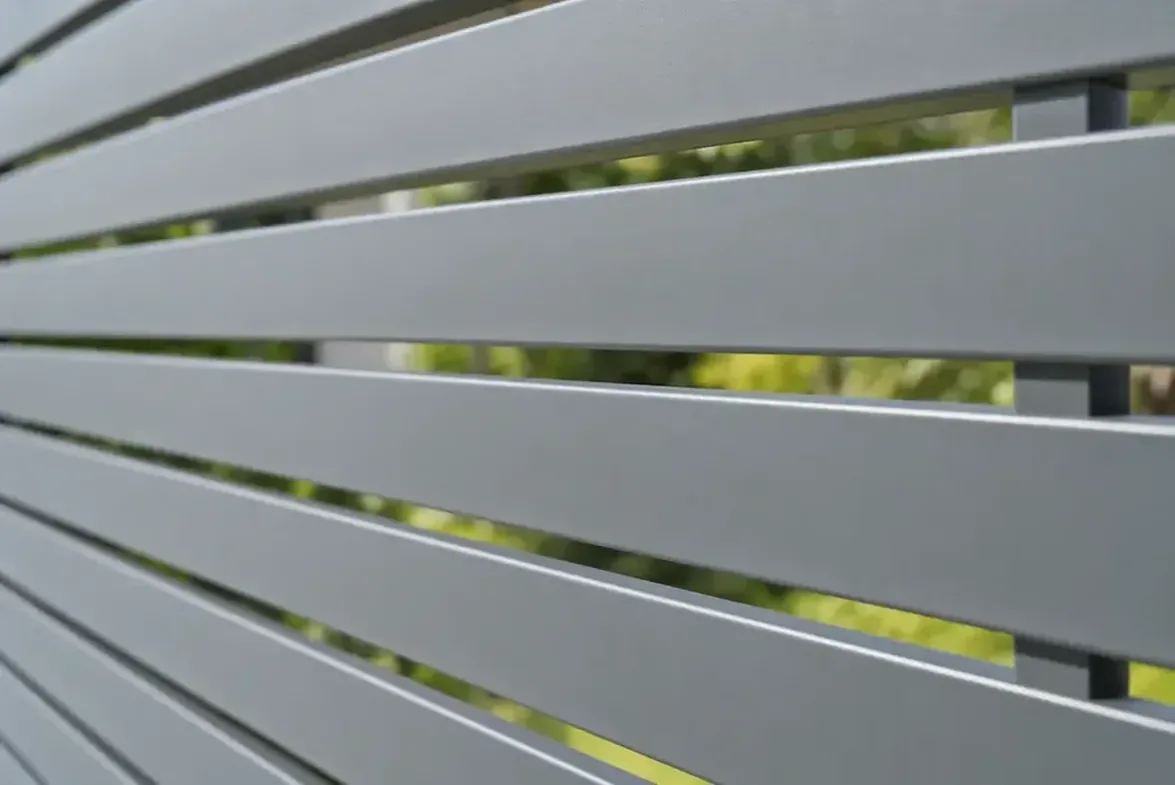
Every blade, post and rail is aluminium, powder-coated before it arrives on site. Aluminium does not rust like raw steel, and the baked finish holds its colour through cold, wet winters. A wash down now and then is the whole maintenance list.
- No rust, no rot
- Baked-on powder-coat finish
- Wash down and forget it
Light and Airflow
Screening Without Boxing the Yard In
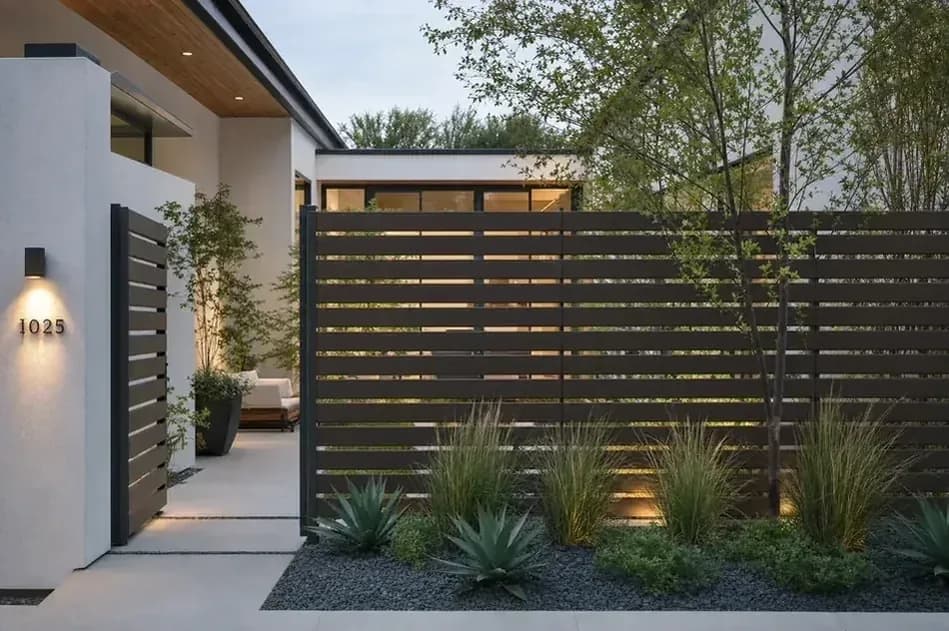
The gap between slats is set at the design stage, so you decide how much light and air comes through. A tight gap screens a courtyard or a pool pump. A wider one keeps a small front yard feeling open instead of walled off.
- Gap set to suit the spot
- Breaks sightlines, keeps light
- Wind passes through, not into it
Street Appeal
The Fence People See First
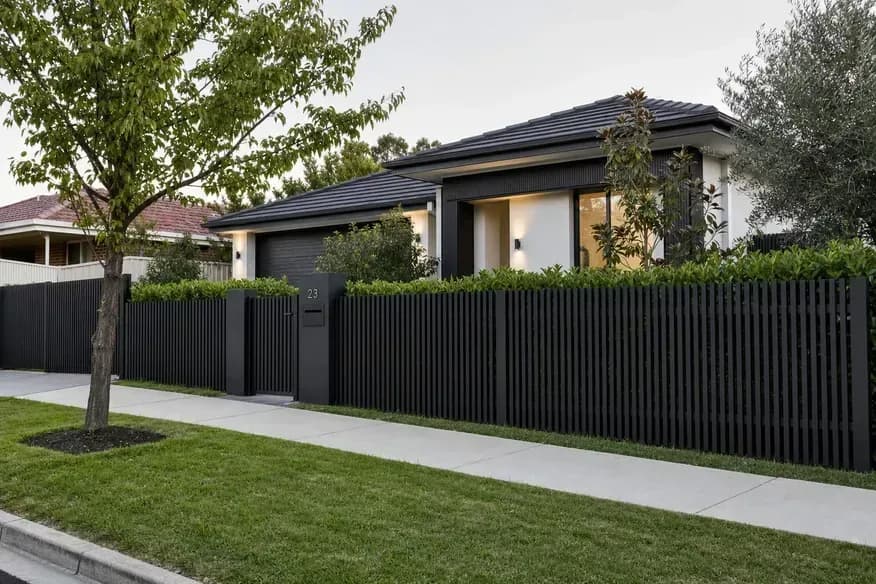
A horizontal slat run gives a frontage a straight, deliberate line that lifts the whole facade. It pairs with a matching slat gate so the driveway and the boundary read as one piece.
- Clean architectural line
- Matching slat gates
- Looks the same from both sides
Compare
Aluminium Slat vs Colorbond vs Timber
Slat fencing is not the right answer for every boundary. Here is an honest look at where it wins and where one of the other two is the smarter buy.
| Aluminium Slat | Colorbond | Timber | |
|---|---|---|---|
| Cost per metre | Highest of the three | Lowest of the three | In between |
| Privacy | Partial, set by the gap | Full, no gaps | Full, no gaps |
| Light and airflow | Passes through | Blocked | Blocked |
| Maintenance | Occasional wash | Just hose it down | Oil or paint regularly |
| Rust and rot | Aluminium won't rust | Coated steel, resists rust | Can rot at the ground |
| Look | Sharp and architectural | Clean and modern | Warm and natural |
| Best for | Front fences and screening | Side and rear boundaries | Traditional backyards |
Options
How We Can Build Your Slat Fence
Slat fencing is a set of decisions rather than one product. These are the five that shape how your run looks, what it costs and how much it screens.
Horizontal slats Most popular
Blades run left to right across the frame, which is the look most people picture when they ask for a slat fence. It widens a frontage visually and is the usual pick for a front boundary or a driveway gate to match.
Vertical slats
Blades run top to bottom, which reads taller and more traditional against a period home. It also sheds water and leaf litter faster than a horizontal run, which is worth thinking about under trees.
Slat gap and spacing
The gap between blades is the single biggest call you make, because it trades privacy against light and airflow. A tight gap screens close up but darkens the space behind it, while a wider gap keeps things open and lets more through.
Blade profile and width
Slats come in different widths and depths, from slim blades that give a fine, repeated line to wider boards that read solid and heavy. Wider blades mean fewer slats per run, narrower blades mean more of them and more fixing work.
Finish and colour
Powder-coat comes in a range of colours, so you can pick something that sits with your roof, your window frames or your render. Timber-look finishes are also available if you want the warmth of wood without oiling it every couple of years.
Cost
What Affects the Price of a Slat Fence
Slat fencing prices differently to a standard panel run, because you are paying for the number of blades and the fixing work behind them, not just the metres. We quote on site so you can see exactly where the number comes from.
Length of the run
Lineal metres set the base number. Longer runs usually work out better per metre, because setup, delivery and set-out are spread across more fence.
Fence height
A taller run needs more blades and heavier posts to stay rigid. Front fences are often lower than a rear boundary, which pulls the cost per metre down.
Slat spacing and blade count
This is the one that surprises people. Halving the gap roughly doubles the number of slats in the run, and every extra blade is more material and more fixing time.
Blade profile
Wider, deeper blades cost more each but you need fewer of them, and slim blades cost less each but you need many more. The profile you pick changes the price and the look together.
Site access and ground
Rock and heavy clay slow post holes right down. Narrow side access, steps or carrying materials through the house all add hours to the install.
Gates and extras
Matching slat gates, automation, letterbox and pier returns and colour upgrades sit on top of the base run. Each one is listed separately so you can add or drop it.
Dividing fences between two properties are generally a shared cost in Tasmania, though the share is usually based on a standard fence rather than an upgrade. We will give you a written, itemised quote you can hand straight to your neighbour, and flag anything that needs a check with the City of Launceston.
How It Works
From Quote to Finished Fence
Four steps and no surprises. The crew that measures your block is the crew that installs the fence.
Free on-site measure
We walk the line, check levels and boundaries, and talk through orientation, slat gap, blade profile and colour so you can picture the finished run.
Written quote in 48 hours
You get a clear, itemised quote in writing, with the gates and extras listed separately. No deposit pressure and no vague on-the-spot numbers.
Supply and install
We concrete the posts, hang the frames and set every blade to the same spacing so the run reads straight from any angle.
Final walk and clean-up
We walk the finished fence with you, check the gate swing and latch, sort any last details and leave the site tidy.
The Spec
What's in a Prime Fencing Slat Fence
Every slat run we install is built to the same spec, whether it is a three metre screen or a full frontage.
- Standard heights
- 1.2m, 1.5m, 1.8m
- Material
- Powder-coated aluminium
- Slat profiles
- Slim, standard and wide blade
- Posts
- Aluminium, set in concrete footings
- Finish
- Powder-coat colours or timber-look
- Fixings
- Concealed, corrosion-resistant
FAQs
Aluminium & Slat Fencing Questions, Answered
It depends on the length, the height, the slat spacing and the blade profile you pick, so we quote every job on site. Slat fencing generally costs more per metre than a standard panel run, because you are paying for the blades and the fixing work behind them. You will get a written price within 48 hours.
It gives you partial privacy rather than full privacy, and how much depends on the gap you choose. A tight gap breaks sightlines from the footpath and from a neighbouring window, but someone standing square on and close up will still see movement. If you want a solid boundary, we will point you at a panel fence.
Horizontal is the more common choice and it makes a frontage read wider and more contemporary. Vertical reads taller, sits better against a period home, and sheds water and leaf litter faster under trees. We will show you both against your house at the measure.
Aluminium does not rust the way raw steel does, and the powder-coat is baked on rather than painted, so it holds up well outdoors. Any exterior finish will weather slowly over many years, and darker colours show that sooner than lighter ones. A wash down a couple of times a year is all it asks for.
There is no single right answer, because it is a trade between privacy and light. A narrow gap screens better but darkens the space behind it and costs more, since the run needs more blades. We will hold a sample up on site so you can see the difference before you decide.
Yes. On a slope we usually step the panels down the fall so each frame stays level and the slat lines stay true. On a gentle grade we can rake the run instead, and we will show you which one suits your block at the measure.
Yes, and it is the usual way we build these. We make pedestrian and driveway gates from the same blade profile, spacing and colour so the gate disappears into the run. Automation can be added to a driveway gate if you want it.
It is one of the best uses for it, because it screens the yard without walling the house off from the street. Front fences can have different height and setback rules to a rear boundary, and corner blocks and heritage areas differ again. We will flag anything that needs a check with the City of Launceston.
Most residential slat runs go in within a day or two once the materials arrive. Longer frontages, tight access, gates and automation can push that out, and we will give you a realistic window with the quote rather than after you have signed.
Other Fencing We Build
We install aluminium & slat fencing across greater Launceston, including Riverside, Prospect, Kings Meadows, Newnham, Mowbray and the wider Tamar Valley.
Ready to Fence Your Block?
Book a free on-site quote and we'll give you a real number in writing within 48 hours. No deposit, no obligation.